
Can My Vehicle Tow This Camper?
Buying too much camper is easy to do. One number on a window sticker looks big enough, and the other five never come up until the truck is already struggling on the highway.
Can my vehicle tow this camper? It’s the question we hear most at International RV World, and the honest answer is almost always “it depends on more than the tow rating.”
Most buyers chase a single figure to settle it. Usually the tow rating in the owner’s manual. That number is real, but it assumes a nearly empty truck. So can my truck tow a camper? This tow capacity guide covers the numbers that actually decide it, so you can answer that for your own truck before you fall for a floorplan.
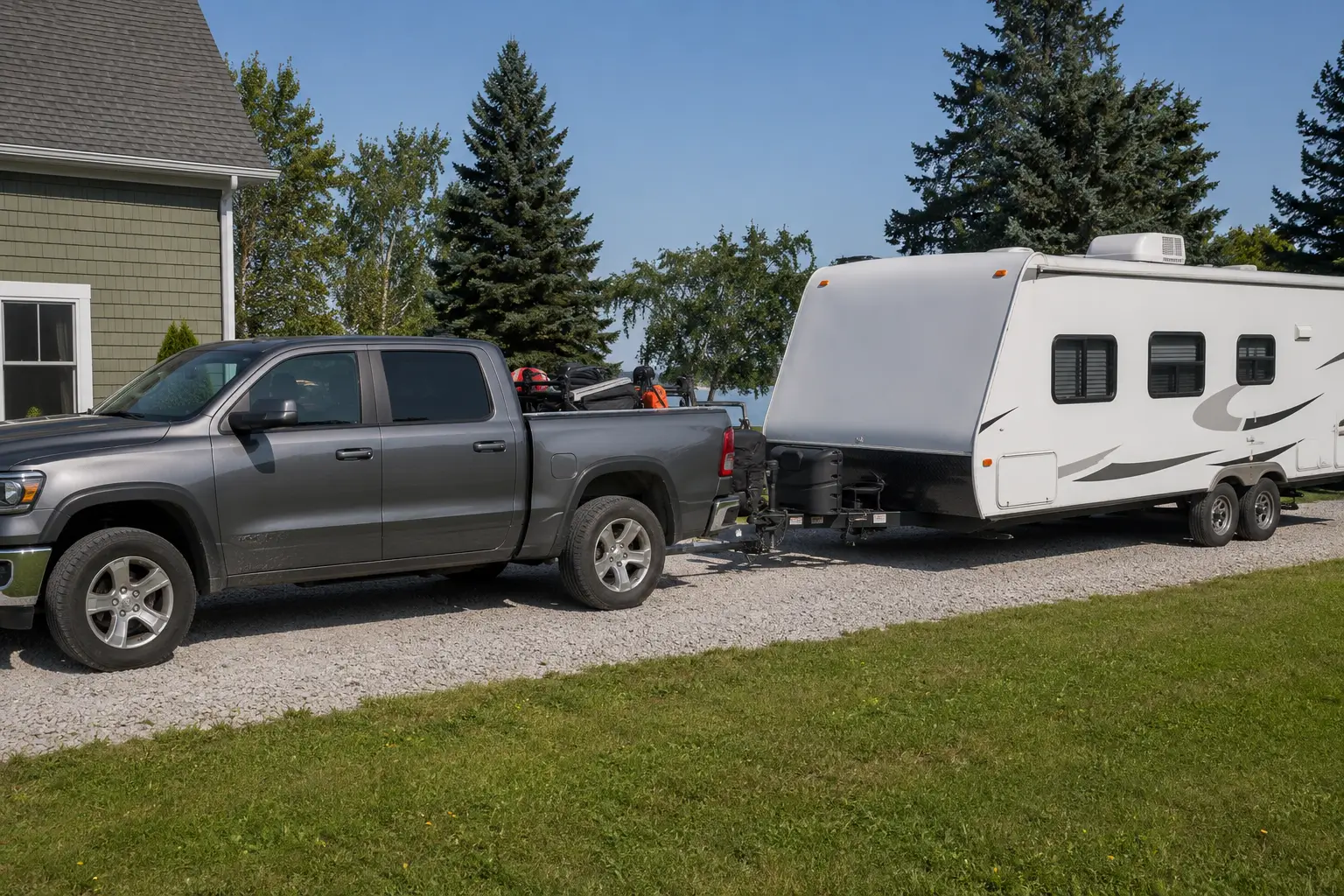
What Determines Whether Your Vehicle Can Tow a Camper?
Six numbers set the limit. Only one shows up in the truck ads.
- Tow rating. The most your vehicle is rated to pull.
- Payload capacity. The most it can carry, including people, gear, and hitch weight.
- GVWR. The most your loaded vehicle is allowed to weigh.
- GCWR. The most your vehicle and camper are allowed to weigh together.
- Axle ratings. What each axle can hold on its own.
- Hitch rating. Your receiver and ball each have a limit, often lower than the truck’s.
All six have to clear. Whichever one you hit first is your real ceiling. For most people asking “can my truck tow a camper,” that ceiling turns out to be payload. Payload is also the number nobody puts on a window sticker.
Towing Terminology Explained
Travel trailer coupler and weight distribution hitch with tongue weight explained
The weight labels on a camper use terms that sound alike. Here is the towing terminology explained in plain language.
Dry weight is what the trailer weighed leaving the factory. Empty tanks, bare cabinets, nothing you would pack. It’s the lightest that rig will ever be, and it’s the number that sells trailers.
GVWR is the most a camper is allowed to weigh once loaded. Understanding dry weight vs GVWR keeps buyers out of trouble. A loaded camper usually runs 1,000 to 1,500 pounds heavier than its dry weight. Run your math against GVWR every time. Dry weight vs GVWR is where most bad purchases begin.
Cargo carrying capacity is GVWR minus dry weight. That’s your room for water, propane, and gear.
Tongue weight is the downward push a travel trailer puts on the hitch ball. In lay terms, tongue weight runs about 10 to 15 percent of the loaded trailer weight. That load counts against your payload. Buyers who get tongue weight explained to them early tend to avoid the numbers that don’t hold together.
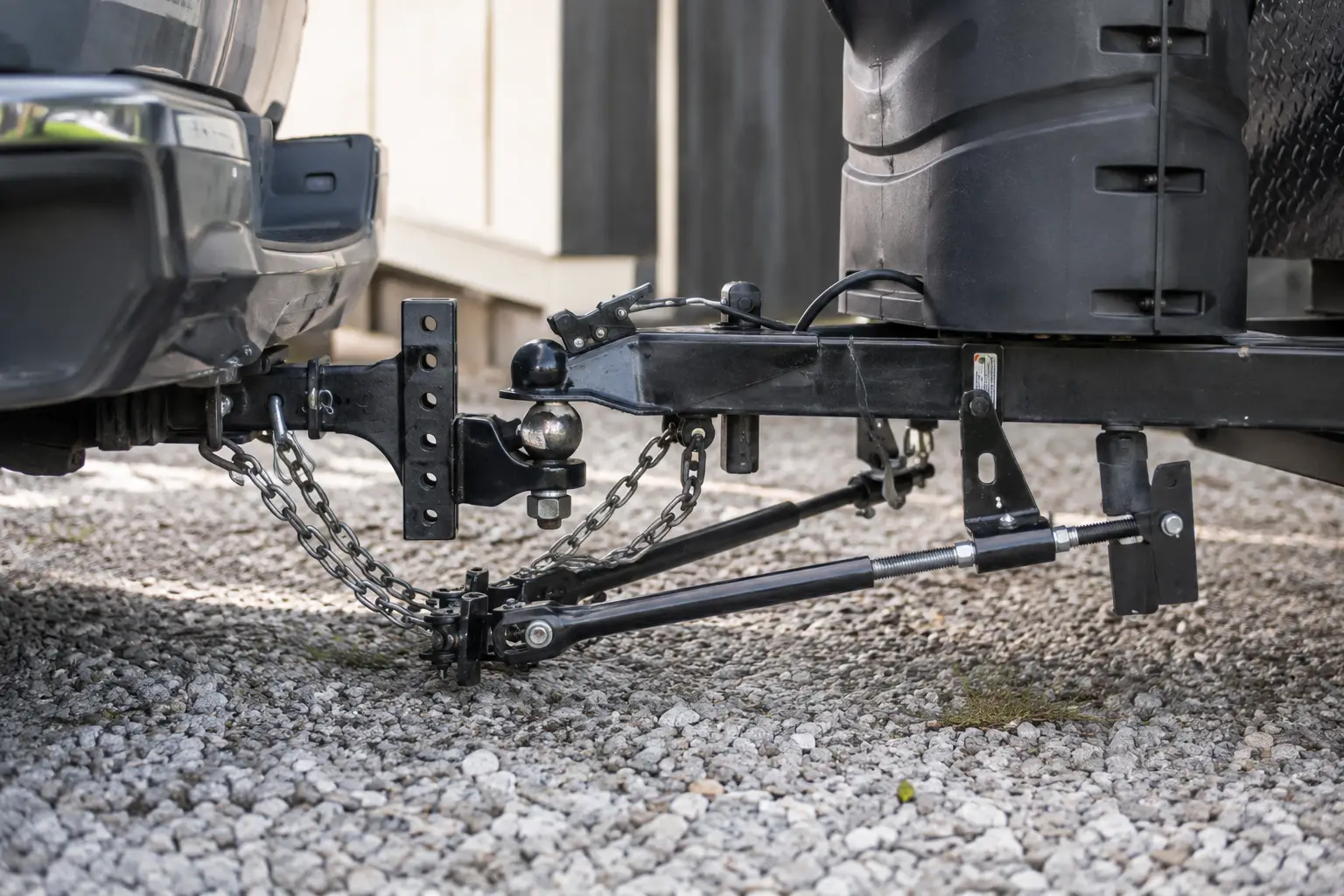
Hitch weight is another name for that same downward force. Your receiver carries its own hitch weight rating, separate from the truck’s. A hitch weight limit of 800 pounds caps you no matter how strong the engine is.
Pin weight is the fifth wheel version. It sits in the truck bed and runs heavier, around 15 to 25 percent of loaded weight.
Why Payload Matters More Than Most Buyers Realize
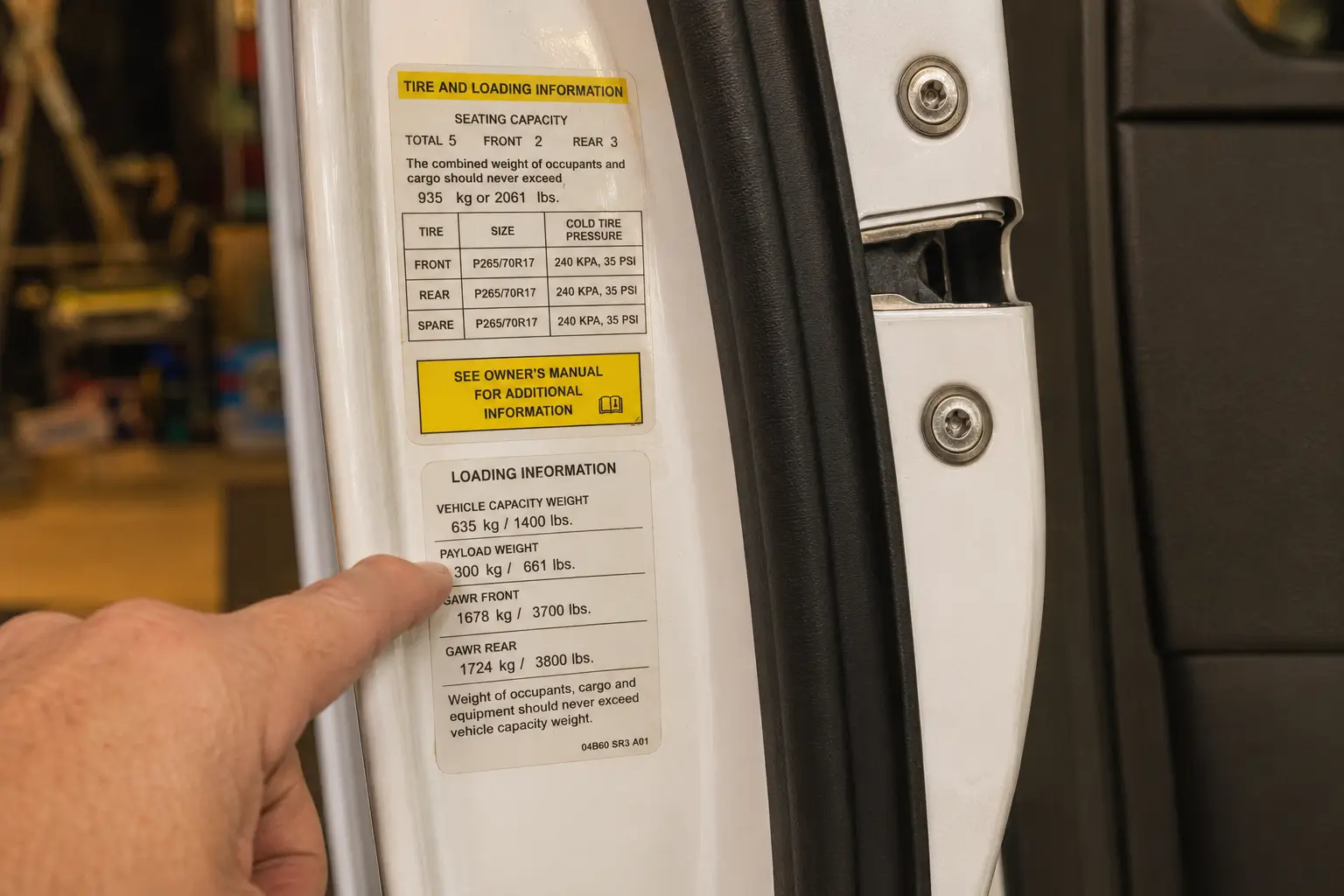
Reading the door jamb sticker to calculate towing capacity and check payload vs towing capacity
Payload vs towing capacity trips up more buyers than any other pair of numbers. Tow rating covers what you pull. Payload covers what you carry. Your camper’s tongue weight lands in the payload column rather than the tow column.
Open your driver’s door and look at the jamb. The sticker lists a combined limit for passengers and cargo. That number is your real budget.
Now spend it. Passengers. The dog. Coolers and camp chairs. Bikes on a rack. A weight distribution hitch. The tongue weight of the trailer itself. A half-ton crew cab with a full family aboard can use half its payload before the camper is even connected.
That’s how a truck rated for 11,000 pounds of towing ends up over its limit behind a 7,000-pound trailer. The tow rating had room. The payload did not. That gap between payload vs towing capacity is the whole trap. Camper towing weight is a payload problem far more often than a power problem. Once you see camper towing weight that way, the math stops being a mystery.
How to Calculate Towing Capacity for Your Vehicle
Learning how to calculate towing capacity for your specific rig takes about fifteen minutes.
Find your VIN. It’s on the driver’s dash or the door jamb.
Check the owner’s manual. The towing tables sit in the back, sorted by engine and axle ratio.
Read the door jamb sticker. Your payload number lives here. Trust it over any forum post.
Confirm your exact trim. Two similar trucks can differ by 1,500 pounds of payload.
Check for the factory tow package. Cooling, wiring, and hitch all ride on it. Without it, real capacity sits well under the headline.
The formula behind how to calculate towing capacity is short. Take your GCWR, subtract your curb weight, then subtract everything you are carrying. What’s left is what the camper can weigh.
One more thing worth knowing. Since the 2013 model year, most brands rate tow capacity against the same test standard. That makes truck towing capacity easier to compare across makes. On older rigs the ratings are less reliable.
What Size Camper Can I Tow?
Full-size SUV towing capacity matched to a lightweight travel trailer
The ranges below are rough. Your trim decides the real number, so check the sticker. Here is what size camper can I tow, sorted by vehicle type.
- Compact SUV. Around 1,500 to 3,500 pounds. Teardrops and small pop-ups.
- Mid-size SUV. Around 3,500 to 6,000 pounds. Pop-ups and light single-axle trailers.
- Full-size SUV. Around 6,000 to 9,000 pounds. Mid-size travel trailers, with payload watched closely.
- Half-ton pickup. Around 7,000 to 13,000 pounds. Most travel trailers, plus lighter fifth wheels when the payload allows.
- Three-quarter-ton. Around 12,000 to 20,000 pounds. Large trailers and most fifth wheels.
- One-ton. 15,000 pounds and up. Big fifth wheels and loaded toy haulers.
So can an SUV tow a travel trailer? Plenty can. A mid-size SUV rated at 5,000 pounds handles a light single-axle trailer, as long as the loaded weight stays under that with room to spare. SUV towing capacity gets eaten by a full third row more than by the engine. Check SUV towing capacity on the door sticker itself. The brochure figure won’t tell you your trim’s real limit.
Truck towing capacity gives you more room. Even so, the half-ton truck towing guide answer still surprises people every spring. A good half-ton truck towing guide starts with pin weight. On a modest fifth wheel it can reach 1,600 pounds. A half-ton with a 1,700-pound payload has almost nothing left for passengers after that. Any honest tow capacity guide lands in the same place. The truck runs out of carrying capacity before it runs out of pulling power.
Common Towing Mistakes to Avoid
We watch buyers make the same misses all year.
- Shopping against dry weight instead of GVWR.
- Forgetting payload entirely.
- Leaving passengers and gear out of the math.
- Skipping the hitch weight rating on the receiver.
- Buying the biggest camper the truck can technically pull.
That last one is worth a closer look. The trailer sitting at the very top of your rating is usually the wrong one to buy. The safest towing weight sits around 80 percent of your maximum. That buffer covers wind, hills, and hard braking. Aiming for the safest towing weight also makes for a far less tiring drive.
Travel Trailer vs Fifth Wheel: Which Is Easier to Tow?
These two tow differently, and any travel trailer towing guide worth reading says so. A travel trailer hooks to a ball on the rear receiver, often with a weight distribution setup. A fifth wheel mounts to a plate in the truck bed.
Fifth wheel pin weight in a half-ton truck bed against truck towing capacity
The fifth wheel carries its weight over the rear axle. It tracks steadier and sways less. It also pivots sharper, which takes practice in a tight campground. A travel trailer is more forgiving to park, though it feels twitchier in crosswinds. The real catch with a fifth wheel is the truck it demands. This travel trailer towing guide comparison usually ends at payload, since a fifth wheel wants a pickup with room to spare.
How International RV World Helps You Find the Best Camper for Your Truck
Working out what camper can my vehicle tow is doable on your own. It’s also a lot of numbers, and one wrong figure gets expensive.
Bring us your year, make, model, and trim. We’ll read the sticker with you and tell you straight what fits. The best camper for my truck is rarely the biggest one on the lot, and we would rather you hear that now than after the sale. We square your payload against real tongue and pin weights, then point you toward rigs that match.
Sometimes the honest answer is that you need a different tow vehicle. We’ll say so. When that happens, we can put a number on your current rig and walk through the financing on a setup that pulls right. Either way, you leave knowing what camper your vehicle can tow.
Buyers drive to Bay City from across mid-Michigan because we answer that question before we talk price. Send us your vehicle’s numbers and we’ll take it from there.
Frequently Asked Questions
Can an SUV tow a travel trailer?
Yes, within limits. Mid-size and full-size SUVs handle light to mid-size trailers when the loaded weight and tongue weight both fit the ratings. Read the door sticker, since trim moves SUV towing capacity around.
Is dry weight the same as towing weight?
No. Dry weight is the empty camper from the factory. What you tow is the loaded weight, usually 1,000 to 1,500 pounds heavier. Use GVWR.
How much towing buffer should I leave?
About 20 percent under your maximum. Staying near 80 percent gives you the safest towing weight for hills and wind.
Do I need trailer brakes?
In Michigan, and most states, trailers over a set weight need their own brakes. Nearly every camper we sell has them, and you’ll want a brake controller in the tow vehicle.
Can I tow at maximum capacity?
You can. Most people shouldn’t. Riding the limit leaves no margin for a rough day on the road.
Bring Us the Numbers
The honest answer to “can my vehicle tow this camper” is usually yes, with the right camper. Finding that camper is the part worth getting right.
Grab your VIN and your vehicle’s year, make, and trim. We’ll help you land on the best camper for my truck by working the real numbers with you. We’ll tell you what you can pull and what you would be smart to pull. Those are rarely the same rig.
Ready to find out for sure? See what’s on our lot at International RV World and we’ll match you to a camper your truck can actually handle.
